
Post-Purchase
Know Your Ground
Buying Vacant Land in Florida: The Honest Guide (2026)
You found a piece of land in Florida you love. The price looks right. The location works. And you can already picture yourself there — fishing, farming, building, or just getting away from the city.

Buying Vacant Land in Florida: The Honest Guide (2026)
You found a piece of land in Florida you love. The price looks right. The location works. And you can already picture yourself there — fishing, farming, building, or just getting away from the city.
But before you wire a deposit, there are four things about Florida that will not come up in a typical listing description. Skipping any one of them can cost you thousands of dollars or leave you owning land you cannot legally use the way you planned.
Buying land in Florida is genuinely one of the best moves you can make if you do the homework first. Florida has more than 18 million acres of private land, owner financing is widely available, and there are still counties where you can buy a good parcel for under $20,000. But the state also has more wetlands than any other contiguous state in the country, one of the highest flood risk profiles in the nation, active sinkhole zones, and county zoning rules that vary wildly from one place to the next.
This guide walks you through every step, so you go in with clear eyes. We have helped buyers complete owner-financed land purchases across Florida since 2017, and this is the honest version of what you need to know.
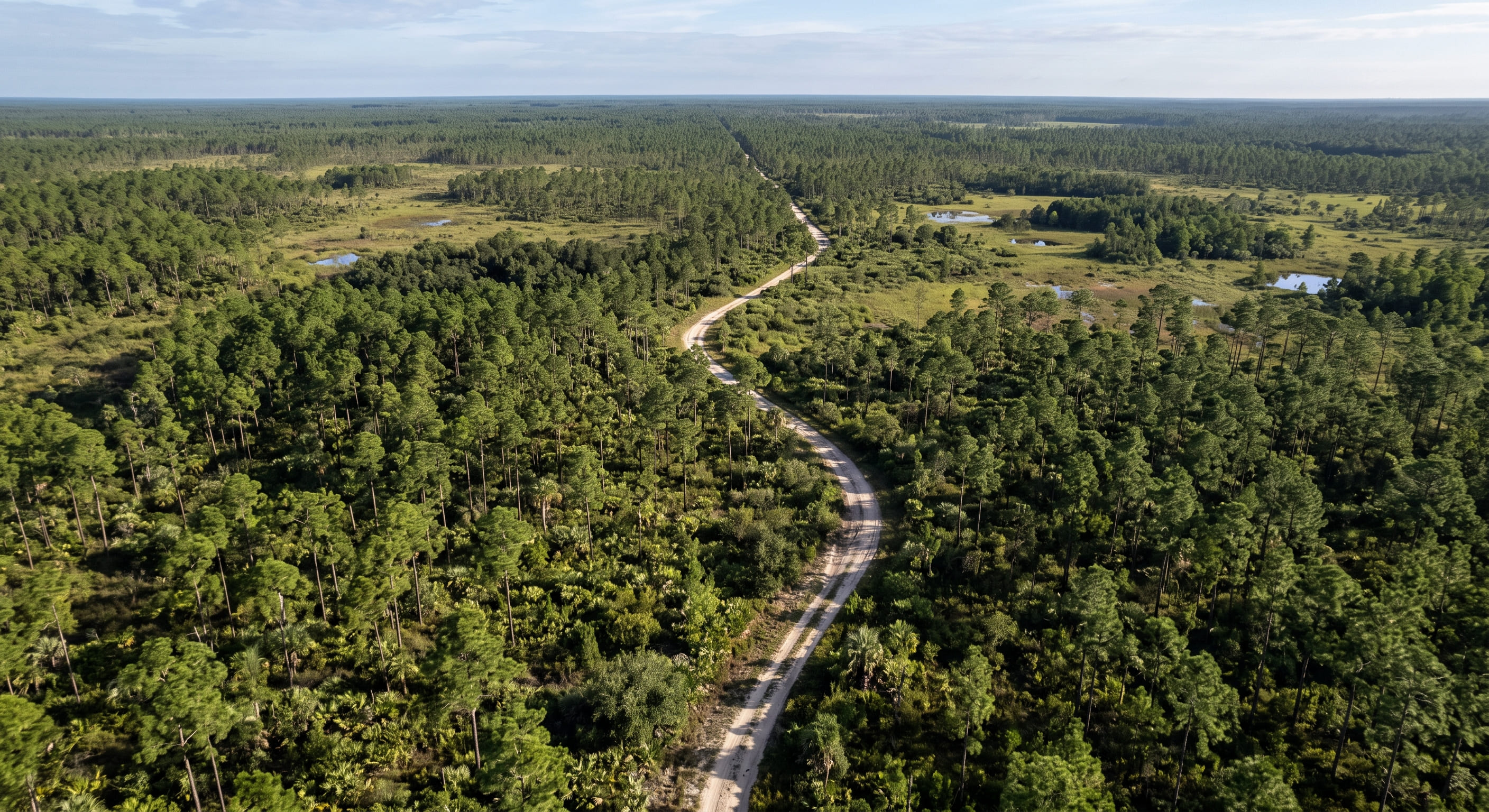
Why Florida Land Is Different From Every Other State
Most land-buying checklists are written for the Midwest or the Mountain West. Florida plays by different rules.
The state sits mostly at sea level. Roughly 29% of Florida's land area is classified as wetlands, the highest percentage of any contiguous U.S. state according to the U.S. Fish and Wildlife Service. That means a meaningful share of the parcels listed for sale contain areas you cannot legally fill, drain, or build on without a federal permit.
Add to that: Florida has the highest concentration of sinkholes in the country. Central Florida (especially Hernando, Hillsborough, Marion, Pasco, Pinellas, Polk, and Sumter counties) sits on a karst limestone foundation that is constantly dissolving underground. Sinkholes can open with little warning.
And the flood risk. FEMA designates large portions of the state as Special Flood Hazard Areas. Coastal counties and low-lying inland areas can flood multiple times per year.
None of this means you should not buy land in Florida. It means you need to check four specific things before you buy: wetlands, flood zone, sinkholes, and zoning. We cover each one below.
"We've closed on Florida land deals where the seller had no idea there were wetlands on the property. It was right there in the National Wetlands Inventory data — free to check in five minutes. That kind of basic due diligence separates a great deal from a disaster."— Andrew, Co-founder, Compass Land USA
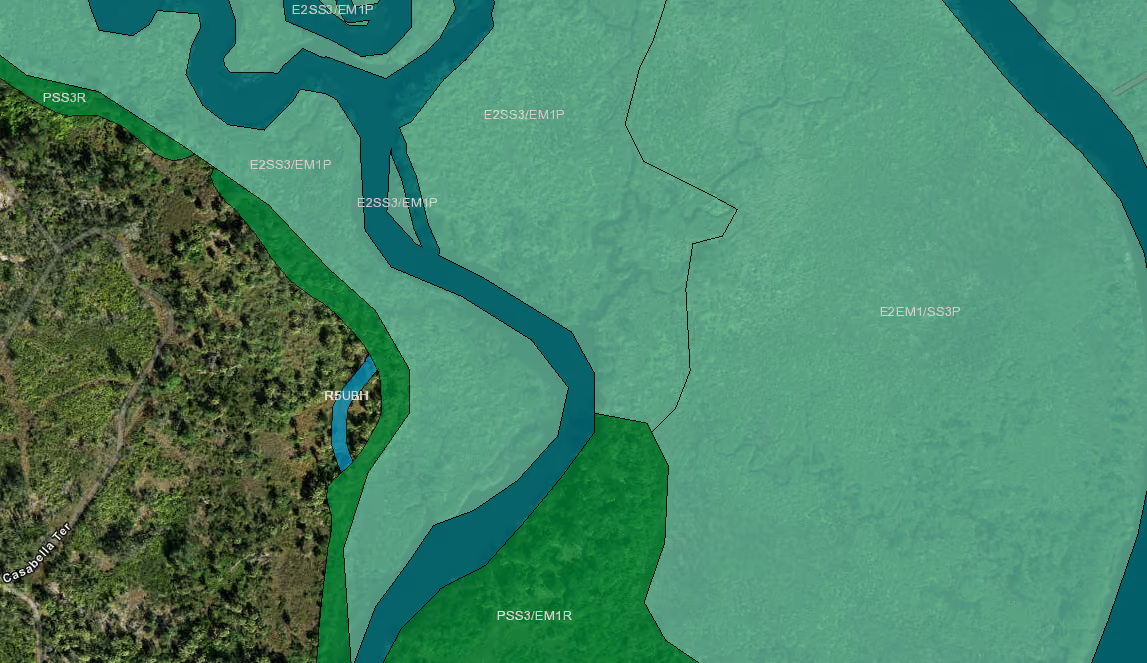
How to Check for Wetlands Before You Buy
Wetlands in Florida are regulated by two agencies: the Florida Department of Environmental Protection (FDEP) and the U.S. Army Corps of Engineers. Under Section 404 of the federal Clean Water Act, placing fill material in a regulated wetland without a permit can result in fines of $25,000 per day and mandatory restoration at your expense.
The fastest free tool is the National Wetlands Inventory (NWI) Mapper at fws.gov/program/national-wetlands-inventory. Type in any address or parcel coordinates and you will see a color-coded map showing wetland boundaries overlaid on your parcel.
A few important caveats:
The NWI map is a screening tool, not a legal determination. The boundaries shown are approximate. If the map shows significant wetland coverage on a parcel you are serious about, hire a wetland delineator before you close. A formal wetland delineation for a small rural parcel (under 5 acres) typically runs $2,500 to $5,000. For larger or more complex parcels, costs can reach $15,000 to $20,000.
If a seller tells you the wetlands on a parcel are "just a seasonal low spot" or "not regulated," get a written professional opinion before you trust that. Jurisdictional wetland determinations are made by the FDEP and the Army Corps, not by sellers.
You should also check property access and road conditions before you finalize any offer. Wetland-heavy parcels often have limited usable acreage, and access routes can cross wet areas that are impassable in rainy season.
How to Check the Flood Zone on Any Florida Parcel
Almost every county in Florida carries some flood risk. Coastal areas and low-lying inland properties near rivers and lakes face the highest exposure.
The official tool is the FEMA Flood Map Service Center at msc.fema.gov. Enter the parcel address or coordinates and you will see which flood zone designation applies.
Here is what the zone labels mean for land buyers:
- Zone X (shaded or unshaded): Moderate or minimal risk. Most lenders and buyers accept these without concern.
- Zone AE: High risk. A 1% annual chance of flooding (the "100-year flood"). If you build here, you will be required to carry flood insurance on any structure.
- Zone VE: Coastal high hazard. Same flood probability as AE but with additional wave action risk. This zone carries the strictest building restrictions.
- Zone A (without a letter suffix): High risk, but detailed flood modeling has not been completed for this area. The exact base flood elevation is unknown.
For vacant land with no structures, raw land itself is not insurable under the National Flood Insurance Program. You won't need flood insurance until you build. But being in Zone AE or VE will affect what you can build, how much it costs to build it, and whether a future buyer can get affordable financing.
Zone X land often sells at only a small discount to comparable flood-free parcels. Zone AE or VE land near water can sell at a 20 to 40 percent discount. That discount can be a good buying opportunity if you understand the restrictions, or a trap if you don't.
If a surveyor documents that the land sits above the Base Flood Elevation and the FEMA map is wrong, you can apply for a Letter of Map Amendment (LOMA) from FEMA to correct the designation. This process takes several months but can significantly increase the property's value and buildability.
"Flood zone land in Florida is not necessarily a bad buy. We've helped buyers find great properties in Zone AE and build smart. The key is understanding what zone you're in before you buy, not after. That's a five-minute check at msc.fema.gov."— Felicia, Co-founder, Compass Land USA
Florida Zoning: What You Can and Cannot Build
Florida's zoning codes are set at the county level, and the range is significant. What you can build in a rural Okeechobee County parcel may be completely different from what's allowed on a similarly priced lot in Putnam County.
The most common zoning classifications for vacant land in Florida are:
Agricultural (A-1, A-2, A-5, etc.): Allows farming, livestock, and usually one single-family residence on the parcel. Most rural land in Florida is agricultural. You can typically park an RV, run power to a well, and build a primary home. Some ag-zoned parcels allow manufactured homes; others do not. Always confirm directly with the county planning office.
Residential (RSF, R-1, R-2, etc.): For subdivided lots in established areas. Setbacks, minimum square footage, and structure type requirements apply. The specific rules vary by county and zoning subdistrict.
Conservation (CON): Very restricted. Land with this designation is typically near protected natural areas and may severely limit or prohibit any development.
Rural (RR, RC): A hybrid found in some counties. Often allows residential use on larger lot minimums.
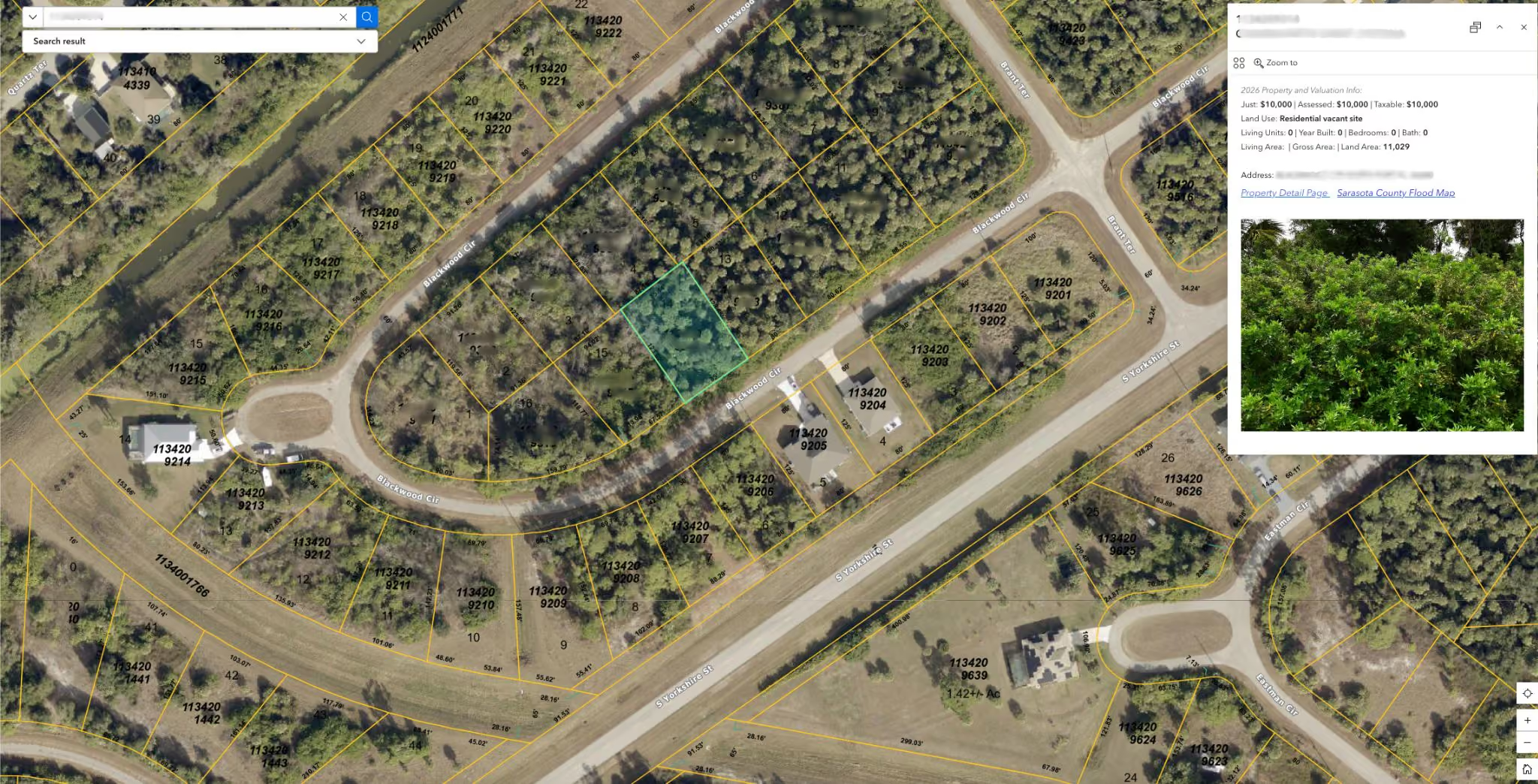
To check zoning on any Florida parcel, go to the county property appraiser's website, look up the parcel by APN or address, and find the zoning code listed in the property details. Then cross-reference that code with the county's land development regulations (LDR), which are usually posted on the county planning department website.
Felicia, who has reviewed zoning on hundreds of Florida parcels since 2017, recommends calling the county planning department directly after you look it up online. "The online zoning maps are often months behind any recent code changes. A five-minute phone call to the county planner confirms everything and protects you."
You can also check land zoning regulations in Florida with our step-by-step guide to looking up any county's codes.
The Documentary Stamp Tax and Other Florida Closing Costs
Florida charges a documentary stamp tax on every real estate deed transfer. For most Florida counties, the rate is $0.70 per $100 of the purchase price. In Miami-Dade County, the rate is $0.60 per $100, plus a $0.45 per $100 surtax, for a combined rate of $1.05 per $100.
On a $20,000 parcel outside Miami-Dade, the documentary stamp tax would be $140. On a $50,000 parcel, it would be $350.
Other typical buyer closing costs for Florida vacant land include:
- Recording fees: $100 to $200, paid to the county clerk to record the deed
- Title search: $150 to $400, confirms clear ownership and checks for liens
- Title insurance (optional but recommended): Usually 0.5% to 1% of the purchase price
- Survey: $500 to $1,500 for a boundary survey on a typical rural parcel
- Attorney fees: Varies; a Florida real estate attorney typically charges $500 to $1,500 for a land transaction review
Total buyer closing costs in Florida typically run 2% to 5% of the purchase price. On a $30,000 land purchase, budget $600 to $1,500 for closing.
One thing worth noting: Florida does not legally require a survey to close on a land purchase. But skipping a survey on a rural parcel is a real risk. Property line descriptions in older deeds often do not match current GPS coordinates. A boundary dispute discovered after closing is far more expensive than a survey paid before closing.
To get a full picture of what you'll owe, check property back taxes and tax liens on any Florida parcel before you make an offer. Outstanding liens follow the land, not the previous owner.
Which Florida Counties Have the Most Affordable Land
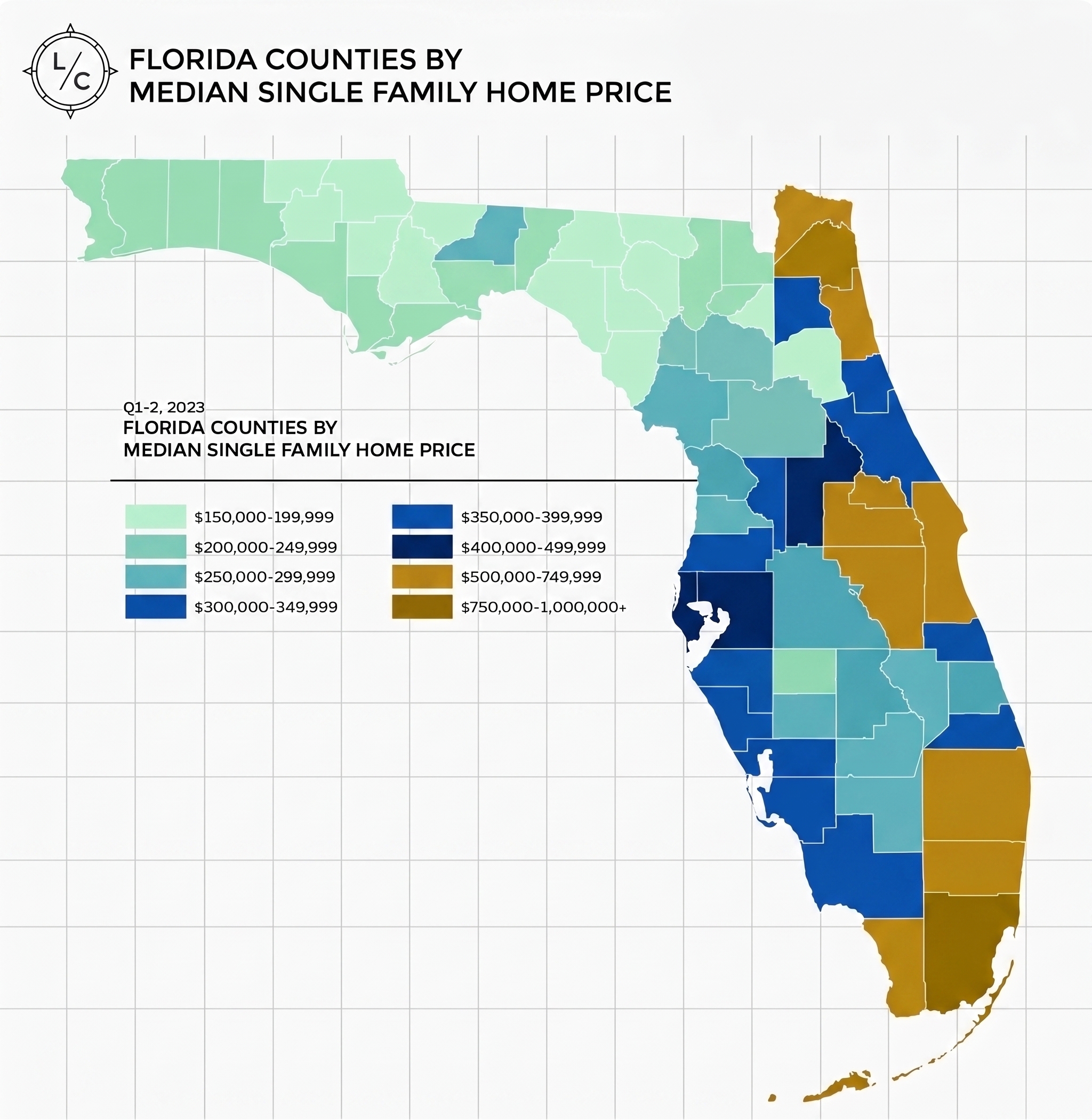
Florida's land prices vary enormously by region. Coastal counties like Miami-Dade, Broward, and Palm Beach average well over $100,000 per acre for raw land. The Panhandle and rural North Florida offer a completely different market.
The most affordable counties for vacant land buyers in 2026 are concentrated in the Panhandle and rural North and Central Florida:
CountyAverage Price Per AcreNotesHolmes County~$7,700Panhandle; lowest in the stateCalhoun County~$8,200Panhandle; very ruralJackson County~$8,800Panhandle; good road networkMadison County~$10,100North Florida; timber and farmlandHamilton County~$12,300North Florida; sinkhole-adjacentOkeechobee County~$24,000South-Central; near Lake Okeechobee
The statewide average across all land types is approximately $22,500 per acre. Panhandle counties represent some of the best value in the state, with the tradeoff that these areas are more rural and farther from major employment centers.
According to Andrew, co-founder of Compass Land USA, the buyers who tend to get the best value in Florida are those who are flexible on county: "If you're set on a specific county, you'll pay a premium. If you're open to the right land in the right price range, the Panhandle and North-Central Florida have deals that the coastal buyers never even look at."
Browse our current land for sale in Florida to see available properties with owner financing.
HOAs on Vacant Land: How to Find Out Before You Buy
Many land buyers assume HOA fees only apply to houses and condos. That's not always true. Subdivided rural lots and planned land communities in Florida can carry POA (Property Owners Association) or HOA fees that apply to vacant parcels.
The fee amounts on raw land are typically lower than in developed neighborhoods. Common charges cover shared road maintenance, entrance gate upkeep, or common area mowing. But even $50 to $200 per year adds up, and some associations have fees that are much higher.
How to check before you buy:
- Ask the seller directly. Any listing for land in a subdivision should disclose HOA or POA involvement.
- Search the county property records. Some counties note HOA affiliation in the deed or property record.
- Check with the county clerk of court. Recorded HOA covenants, conditions, and restrictions (CC&Rs) are public records. Search for the subdivision name.
- Read the plat map. If a parcel is part of a recorded subdivision, the plat map (available at the county recorder's office) will reference any covenants attached to the land.
Also pay attention to private deed restrictions beyond formal HOAs. Even on land with no HOA, older deeds sometimes include covenants that restrict structure types (no manufactured homes, no temporary structures), minimum home size, or land use. These covenants can survive for decades and are enforceable in Florida courts regardless of current zoning.
Learn how to check utilities on land before you commit to a parcel, especially if the HOA or subdivision documents reference shared utility infrastructure.
Owner Financing for Florida Land: What to Know
Owner financing is available throughout Florida, and it is one of the most practical ways for buyers to purchase land without going through a bank.
In a typical owner-financed land deal, the seller acts as the lender. You agree on a purchase price, down payment, interest rate, and monthly payment. The most common structure in Florida is a mortgage lien: you receive title to the property at closing, and the seller records a mortgage against the deed that stays in place until you pay off the balance.
A few things to know about owner financing in Florida specifically:
Federal law applies. The Dodd-Frank Act and the SAFE Act apply to certain seller-financed transactions. When a seller is not owner-occupying the property and is financing more than one transaction per year, they may be required to use a licensed mortgage loan originator. Make sure the financing structure you agree to is legally compliant.
Get everything in writing. Florida courts scrutinize land contracts carefully. Use a Florida real estate attorney to review the promissory note and mortgage documents before you sign.
Interest rates on owner-financed land in Florida typically range from 5% to 7%, depending on the down payment, term, and the buyer's profile. Terms of 5 to 15 years are common.
At Compass Land USA, we have structured owner-financed land sales across Florida since 2017. There are no credit checks, no prepayment penalties, and no banks involved. If you have questions about how our owner financing process works, call or text Andrew anytime at (313) 349-0434.
Due Diligence Checklist for Buying Land in Florida
Before you close on any Florida parcel, work through this list:
Wetlands
- Check the National Wetlands Inventory Mapper (fws.gov) for wetland coverage
- If wetlands are present, get a professional wetland delineation before closing
Flood Zone
- Look up the FEMA flood zone designation at msc.fema.gov
- Understand what flood zone means for buildability and insurance
Sinkholes
- Check if the county is in the Florida sinkhole belt (Hernando, Hillsborough, Marion, Pasco, Pinellas, Polk, Sumter)
- Review the Florida sinkhole risk guide for your county
- Consider a geotechnical assessment for larger purchases in high-risk counties
Zoning and Use
- Look up the zoning code on the county property appraiser website
- Call the county planning department to confirm what your intended use is allowed
- Check for any deed restrictions or HOA/POA covenants
Taxes and Liens
- Run a title search to check for back taxes and tax liens
- Verify the current annual tax amount
- Check if the property qualifies for agricultural greenbelt exemption
Access and Utilities
- Confirm road access is legal (deeded easement or county road)
- Check property access and get GPS coordinates
- Check utilities availability (power, water, septic feasibility)
Survey and Title
- Order a boundary survey
- Order a title search or use a title company
- Request title insurance
Closing Costs
- Budget for documentary stamp tax (0.70% of purchase price in most counties)
- Budget for recording fees, title, and any attorney fees
- Total closing costs typically 2% to 5% of purchase price
Frequently Asked Questions About Buying Land in Florida
What should I know before buying land in Florida?
Florida has four land-specific risks that require due diligence before you buy: wetlands, flood zones, sinkholes, and zoning restrictions. Wetlands cover roughly 29% of the state's land area, and regulated wetlands cannot be filled or developed without federal permits. Flood zones affect buildability and insurance requirements. Sinkholes are concentrated in the central Florida limestone belt. And zoning rules vary significantly from county to county. Checking all four takes a few hours and can save you from a very expensive mistake.
What is the documentary stamp tax in Florida?
The documentary stamp tax in Florida is $0.70 per $100 of the purchase price on deed transfers, in most counties. Miami-Dade County has a slightly different rate: $0.60 per $100 base rate, plus a $0.45 per $100 surtax, for a combined rate of $1.05 per $100. This tax is paid to the county clerk of court at the time the deed is recorded. On a $25,000 land purchase outside Miami-Dade, the doc stamp tax would be $175.
How do I check if Florida land is in a flood zone or wetland?
For flood zones, use the FEMA Flood Map Service Center at msc.fema.gov. Enter the parcel address or APN and you will see the flood zone designation. For wetlands, use the National Wetlands Inventory Mapper at fws.gov. Both tools are free and publicly available. If either check shows significant coverage, get a professional assessment before you commit to buying.
Which Florida counties have the cheapest land?
The most affordable counties for vacant land in 2026 are in the Florida Panhandle and rural North Florida. Holmes County averages around $7,700 per acre, followed by Calhoun County at approximately $8,200 per acre and Jackson County at around $8,800 per acre. Madison and Hamilton counties in North Florida are also affordable. Okeechobee County in South-Central Florida averages about $24,000 per acre. These areas offer significantly more value than coastal counties, which can run $100,000 per acre or more.
Are there HOA fees on vacant land in Florida?
Yes, vacant land in Florida can carry HOA or POA (Property Owners Association) fees, especially if the parcel is part of a recorded subdivision. Rural land in planned communities often has fees for shared road maintenance or common area upkeep. To check, ask the seller directly, search county property records, or look up the subdivision's recorded covenants at the county clerk's office. Always read any CC&Rs (covenants, conditions, and restrictions) before you close.
Is owner financing available for Florida land?
Yes. Owner financing is widely available for vacant land in Florida. The seller acts as the lender, and you agree on a down payment, interest rate, and monthly payment. Title typically transfers to you at closing with the seller holding a recorded mortgage. Interest rates usually range from 5% to 7%. Federal rules under the Dodd-Frank Act apply when sellers finance multiple properties per year, so make sure the deal is structured properly. Compass Land USA offers owner financing on Florida properties with no credit checks and no prepayment penalties.
Do I need a survey when buying land in Florida?
Florida does not legally require a survey to close on a land purchase. But skipping a survey on a rural parcel is risky. Property line descriptions in older deeds often don't match GPS coordinates precisely, and boundary disputes are expensive to resolve after closing. A boundary survey for a typical rural parcel costs $500 to $1,500. For most buyers, that cost is well worth the protection.
What is the agricultural greenbelt exemption in Florida?
Florida's agricultural greenbelt exemption (also called the agricultural classification) can reduce your property tax assessment by 70% or more if the land is used for qualifying agricultural purposes — farming, ranching, timber production, and similar uses. You apply through the county property appraiser's office, and you must demonstrate active agricultural use. If a parcel you're considering is being farmed, it may already carry this classification. If not, it's worth evaluating whether your intended use qualifies.
The Bottom Line on Buying Land in Florida
Florida is a great state to own land. The climate, the access to waterways, the variety of terrain from Panhandle pine forests to Central Florida flatwoods to subtropical South Florida — there's genuine opportunity here for buyers who do the work.
The due diligence steps we covered are not complicated. Most of them take less than an hour using free online tools. The buyers who run into trouble in Florida are almost always the ones who skipped these steps, not the ones who took the time to check.
If you have questions about a specific parcel in Florida, we are happy to talk through it with you. We have been buying and selling land in Florida since 2017, and we know the state-specific issues firsthand.
Call or text Andrew anytime at (313) 349-0434. Or browse our current land for sale in Florida with owner financing at compasslandusa.com.
Andrew
Co-founder, Compass Land USA
Andrew co-founded Compass Land USA after buying and selling land for years without needing a single bank. He's been on both sides of hundreds of owner-financed deals across five states.
You've Read Enough. Time to Own Something.
Ready to Stop Renting Your Life and Start Owning Something?
Browse available land in Arizona, Colorado, Florida, Nevada, and North Carolina. Owner financing on every parcel. No bank. No credit check. Close in days.