



Before You Buy, Manufactured Homes
Before You Buy, Manufactured Homes
Deed Restrictions and HOAs That Block Manufactured Homes — How to Check Before You Buy Land
Deed restrictions and HOA rules can block a manufactured home on land that looks perfect — and most buyers don't find out until after they've paid for due diligence. Here's exactly how to check for restrictions before you sign anything, including the specific words to look for in any deed or CC&Rs document.

You found a beautiful piece of land. The price is right. The location is perfect. You can already picture your manufactured home sitting on that lot, surrounded by open sky.
Then you get to the closing table and find out a deed restriction from 1987 says: "No mobile or manufactured homes allowed."
This happens more than you think. And it is one of the most painful surprises a land buyer can face, because by the time most people discover a deed restriction, they have already paid for inspections, surveys, and due diligence. Some have already signed a purchase contract.
At Compass Land USA, we have bought and sold more than 800 properties across Arizona, Colorado, Florida, and Nevada since 2017. One of the first things we check on every single parcel is whether deed restrictions or HOA rules would block a manufactured home. We are going to show you exactly how to do the same check before you put a single dollar down.
What Are Deed Restrictions, and Why Do They Matter for Manufactured Homes?
A deed restriction is a legal rule tied to a piece of property. It travels with the land, not with the owner. When someone sells the property, the restriction stays. When someone inherits the land, the restriction stays. It can last for decades.
Deed restrictions are sometimes called "restrictive covenants." You will also see them listed in documents called CC&Rs, which stands for Covenants, Conditions, and Restrictions. These show up most often in planned subdivisions, platted communities, and older rural developments from the 1960s through the 1990s.
Here is why manufactured homes get targeted by deed restrictions: when many of these subdivisions were built, manufactured homes had a different reputation than they do today. Developers wrote in restrictions to control what kinds of homes could be placed on lots. Many of those restrictions are still in force today.
According to the U.S. Census Bureau, about 22 million Americans currently live in manufactured homes. Modern HUD-code manufactured homes built after June 15, 1976 must meet federal construction and safety standards that are often stricter than local building codes. But even a brand-new, energy-efficient manufactured home can be blocked by a 40-year-old deed restriction that was written with a very different picture in mind.
What HOA Rules Can Block a Manufactured Home?
A homeowners association (HOA) is a private organization that manages a community's shared rules and common areas. If the land you are looking at sits inside an HOA-governed subdivision, the HOA can enforce restrictions that go beyond what the deed itself says.
HOA rules that commonly block manufactured homes include:
Minimum square footage requirements. Many HOA governing documents require homes to be at least 1,400 or 1,600 square feet. Some go as high as 2,000 square feet. Even a double-wide manufactured home that meets this standard can be blocked if the HOA adds a separate rule about construction type.
"Site-built only" or "stick-built only" language. This is the most direct restriction. Some CC&Rs state that only homes built on-site using traditional framing are allowed. A manufactured home, even a high-end one, does not qualify.
Foundation requirements. Some HOAs require a permanent foundation that makes it hard or impossible to use manufactured home installation systems. Others require a specific type of exterior finish that manufactured homes do not typically use.
Architectural review requirements. Even if there is no outright ban, some HOAs have an architectural review committee that can reject any home design they feel does not fit the community. This can be used to block manufactured homes even when no explicit rule exists.
If land sits inside an HOA, you need to get the full CC&Rs document and read every page. Do not rely on the seller's word or a brief summary.
The Exact Language to Look For in a Deed or CC&Rs
When you pull deed records or CC&Rs, these are the words and phrases that signal a potential block on manufactured homes:
- "No mobile homes"
- "No manufactured homes"
- "No modular homes" (sometimes used broadly, sometimes distinct from manufactured)
- "Stick-built construction only"
- "Site-built homes only"
- "Conventionally built homes only"
- "HUD-code homes prohibited"
- "Minimum [square footage] per dwelling"
- "Permanent foundation required" (check the specific foundation type listed)
- "Residential use limited to single-family, site-built dwellings"
Some restrictions are written more loosely. They may say "homes must conform to the character of the neighborhood" or "homes subject to architectural committee approval." Loose language can still be used to block a manufactured home, so treat it as a yellow flag that requires follow-up.
How to Find Deed Restrictions Before You Buy Land (Step-by-Step)
You do not need to hire an attorney to do a basic deed restriction check. Here is what to do:
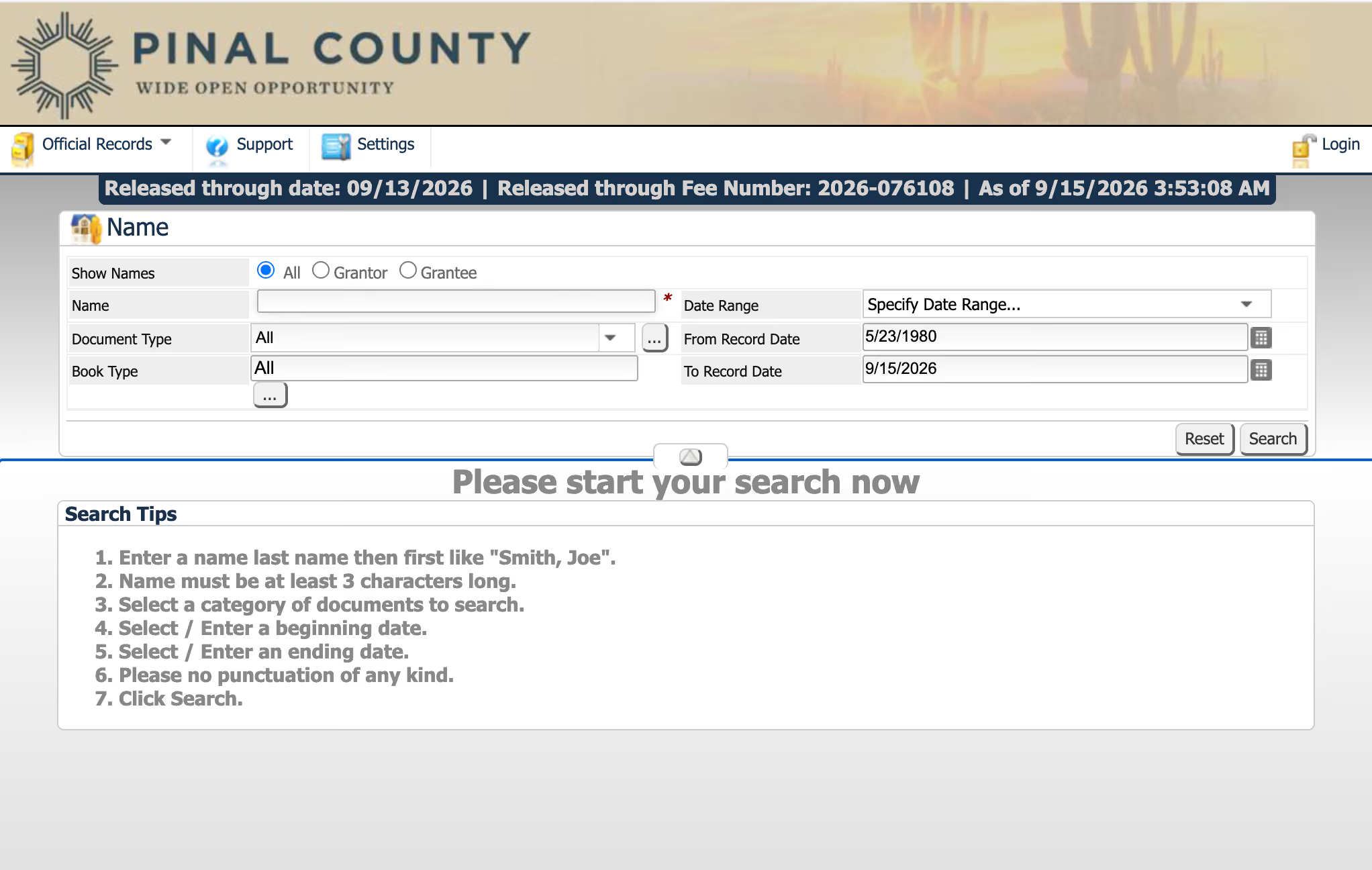
Step 1: Get the property's legal description and parcel number. You can find this on the county assessor's website. Just search the property address or owner name.
Step 2: Search the county recorder or clerk's office. Most county recorders have an online search tool. Search by the parcel number or property address for recorded documents. Look for any document with words like "declaration," "restrictions," "covenants," or "CC&Rs" in the title. Download every one you find.
Step 3: Check the plat map. If the property is part of a platted subdivision, the plat itself may reference a separate restrictions document. Look at the plat map for a note that says something like "subject to recorded restrictions" or "see Declaration of Covenants recorded at [book and page]."
Step 4: Read the full restrictions document. Do not skim. Search for the words listed in the section above. Pay attention to the date the restrictions were recorded and whether they have an expiration clause.
Step 5: Check with the HOA directly (if one exists). If you see an HOA referenced anywhere, call or email them and ask directly: "Does the HOA allow manufactured homes? Are there any restrictions based on construction type?"
Step 6: Ask the county planning or zoning office. Even if there are no private deed restrictions, the county may have zoning rules that limit manufactured homes to certain zones. This is separate from deed restrictions but equally important. You can learn more about zoning for manufactured homes in our article on zoning rules and manufactured homes.
Step 7: Hire a title company to pull a title search. If you are serious about a parcel, a title search will turn up recorded restrictions that might not show up in a basic online search. This typically costs $150 to $400 and is worth every dollar.
We walk through this entire due diligence process in more detail in our complete land due diligence guide. If you want to understand how we check access to a property at the same time, read our guide on how to check property access and get GPS coordinates for free.
What Happens If You Buy Land and Then Find Restrictions?
This is where things get painful. If you close on land without checking for deed restrictions and then discover the restrictions block your manufactured home, your options are limited.
You cannot simply ignore the restrictions. If a neighbor or HOA complains, they can take legal action to stop you from placing the home or force you to remove it after it is already installed. Courts generally enforce deed restrictions as written, even old ones.
Your options at that point are:
Try to get the restriction waived. If a majority of landowners in the subdivision agree, restrictions can sometimes be formally lifted. This process takes time, money, and cooperation from neighbors you may have never met.
File a court action to remove the restriction. In some states, courts will invalidate a deed restriction if it has become unenforceable due to a change in the character of the neighborhood. This is expensive and not guaranteed.
Sell the land and cut your losses. This is what many buyers end up doing. It is a costly lesson.
The best outcome is to never get here. Check before you buy.
Can Deed Restrictions on Manufactured Homes Be Removed or Challenged?
Yes, but it is not simple. Here are the main paths:
Sunset provisions. Some older deed restrictions were written with expiration dates. A restriction from 1972 might say it expires after 50 years. If the expiration date has passed, the restriction may no longer be enforceable. Check the document for any expiration language.
Neighborhood change argument. If a restriction says "no manufactured homes" but the surrounding neighborhood already has several manufactured homes, an attorney can argue the restriction has become unenforceable because it no longer serves its original purpose. This is called the "changed conditions" doctrine. It is a real legal argument, but courts rule inconsistently on it.
Petition from lot owners. In many subdivisions, if a certain percentage of lot owners vote to remove or modify a restriction, it can be lifted. The percentage required is usually stated in the original CC&Rs document.
State law protections. Some states have passed laws that limit the ability of HOAs or deed restrictions to discriminate against manufactured housing. Florida, for example, has specific protections under the Florida Mobile Home Act for residents of mobile home parks. However, these protections do not always apply to vacant land in a subdivision. Check with a local real estate attorney if you are in this situation.
"Every time we look at a parcel, deed restrictions are one of the first three things on my list," says Felicia Munir, co-founder of Compass Land USA. "We have seen buyers lose money on land that looked perfect because nobody checked for a restriction buried in a 1985 declaration. We check every parcel before we list it because we do not want that to happen to our buyers."
What Types of Land Usually Have No Restrictions Against Manufactured Homes?
If you want the cleanest path to placing a manufactured home, look for land with these characteristics:
Unplatted rural land. Land that has never been part of a formal subdivision typically has no deed restrictions at all. These parcels were never divided by a developer who recorded a set of CC&Rs.
Land in agricultural zones. Rural land zoned for agricultural use generally allows manufactured homes without HOA restrictions. Always confirm with the county, but agricultural land is usually the least restricted.
Land sold by counties or government entities. County-owned or tax-lien parcels often come without private deed restrictions because the government does not create the same CC&R frameworks that private developers use.
Older rural lots outside platted communities. Many rural lots sold in the 1950s and 1960s came with no restrictions at all, or with restrictions so old they may have expired.
"When someone tells me they want to put a manufactured home on land and they want the fewest possible headaches, I point them toward unplatted rural parcels," says Andrew Munir, co-founder of Compass Land USA and a land investor since 2017. "You can call me anytime at (313) 349-0434 if you want to talk through what we have available that fits your situation."
You can browse our current vacant land listings in Arizona, Colorado, Florida, and Nevada. Many of our parcels are rural, unplatted, and already confirmed restriction-free for manufactured homes.
How Compass Land USA Checks for Restrictions Before We Sell
We do not list a parcel without checking for deed restrictions first. Here is our standard process:
We start with the county recorder's office. We search by parcel number for any recorded covenants, declarations, or restrictions. We download and read every document that appears.
If the parcel is in a subdivision, we pull the plat map and trace any referenced restriction documents to make sure we have found them all.
We also confirm zoning with the county and note whether manufactured homes are permitted in that zone.
When we list a property, we include what we found. If there are restrictions, we disclose them. If the land is clear of restrictions that would affect manufactured homes, we say that too.
This is part of why buyers trust us. We have closed more than 800 transactions since 2017, and we have never had a buyer come back to us saying they discovered a surprise restriction after closing on one of our properties.
You can learn more about how to buy rural land the right way and what our owner financing options look like if a traditional mortgage is not the right fit for your situation.
FAQ: Deed Restrictions and Manufactured Homes
Does zoning affect whether I can place a manufactured home?
Yes. County zoning rules and private deed restrictions are separate but both matter. A parcel could be free of deed restrictions but still in a zone that limits manufactured housing. Always check both. Read our guide on zoning and manufactured homes for a full explanation.
What if I already bought land and found a restriction after closing?
Consult a local real estate attorney immediately. Your options may include petitioning to have the restriction removed, challenging it in court, or selling the land. Acting quickly matters because any construction or placement that violates a restriction can lead to a court order requiring you to undo the work.
The Bottom Line
Deed restrictions and HOA rules can make or break a manufactured home project. The good news is that checking for restrictions is not hard. It just takes a few hours of research before you sign anything.
Pull the county recorder records. Read the CC&Rs if they exist. Call the HOA. Confirm zoning. And if you want to skip all of that work, buy from a seller who has already done it for you.
At Compass Land USA, every parcel we sell has been checked for the restrictions that matter to manufactured home buyers. We offer flexible owner financing with no credit check required, low down payments, and payments you can actually afford.
Call or text Andrew anytime at (313) 349-0434 to talk through your situation and find land that works for your goals.
Or browse our current listings in Arizona, Colorado, Florida, and Nevada.
Andrew
Co-founder, Compass Land USA
Andrew co-founded Compass Land USA after buying and selling land for years without needing a single bank. He's been on both sides of hundreds of owner-financed deals across five states.
More From the Blog
You've Read Enough. Time to Own Something.
Ready to Stop Renting Your Life and Start Owning Something?
Browse available land in Arizona, Colorado, Florida, Nevada, and North Carolina. Owner financing on every parcel. No bank. No credit check. Close in days.

.png)