Post-Purchase
Before You Buy
FEMA Flood Zones Explained: AE, A, VE, X and What Each Means When Buying Land
Learn what flood zone AE, A, VE, and X mean before you buy land. Plain-English breakdown of every FEMA flood zone designation and what each one costs you.

FEMA Flood Zones Explained: AE, A, VE, X and What Each Means When Buying Land
You found a piece of land at a price you love. You check the listing details, everything looks good, and then you notice a small line in the fine print: "Flood Zone AE." Now you're wondering what that means and whether it should change your decision.
It should absolutely factor in. Flood zone designations affect what you can build, whether you're required to carry flood insurance, how much that insurance costs, and how easy it will be to resell the property down the road.
FEMA flood zones are official designations assigned to every piece of land in the United States based on estimated flood risk. Zones labeled A, AE, or VE sit inside the Special Flood Hazard Area — meaning they have at least a 1% annual chance of flooding, which adds up to a 26% chance of flooding over a standard 30-year period. Zone X, on the other hand, sits outside the high-risk zone and typically carries no mandatory flood insurance requirement. According to FEMA's National Flood Insurance Program, nearly one-third of all flood insurance claims come from properties outside high-risk flood zones, which means every land buyer should understand these designations regardless of which zone their property sits in.
This guide explains every major flood zone type in plain language, what each one means for your plans, and exactly how to look up a property's flood zone for free before you buy.
What Is a Special Flood Hazard Area?
Before getting into the individual zone types, you need to understand the concept that ties them together.
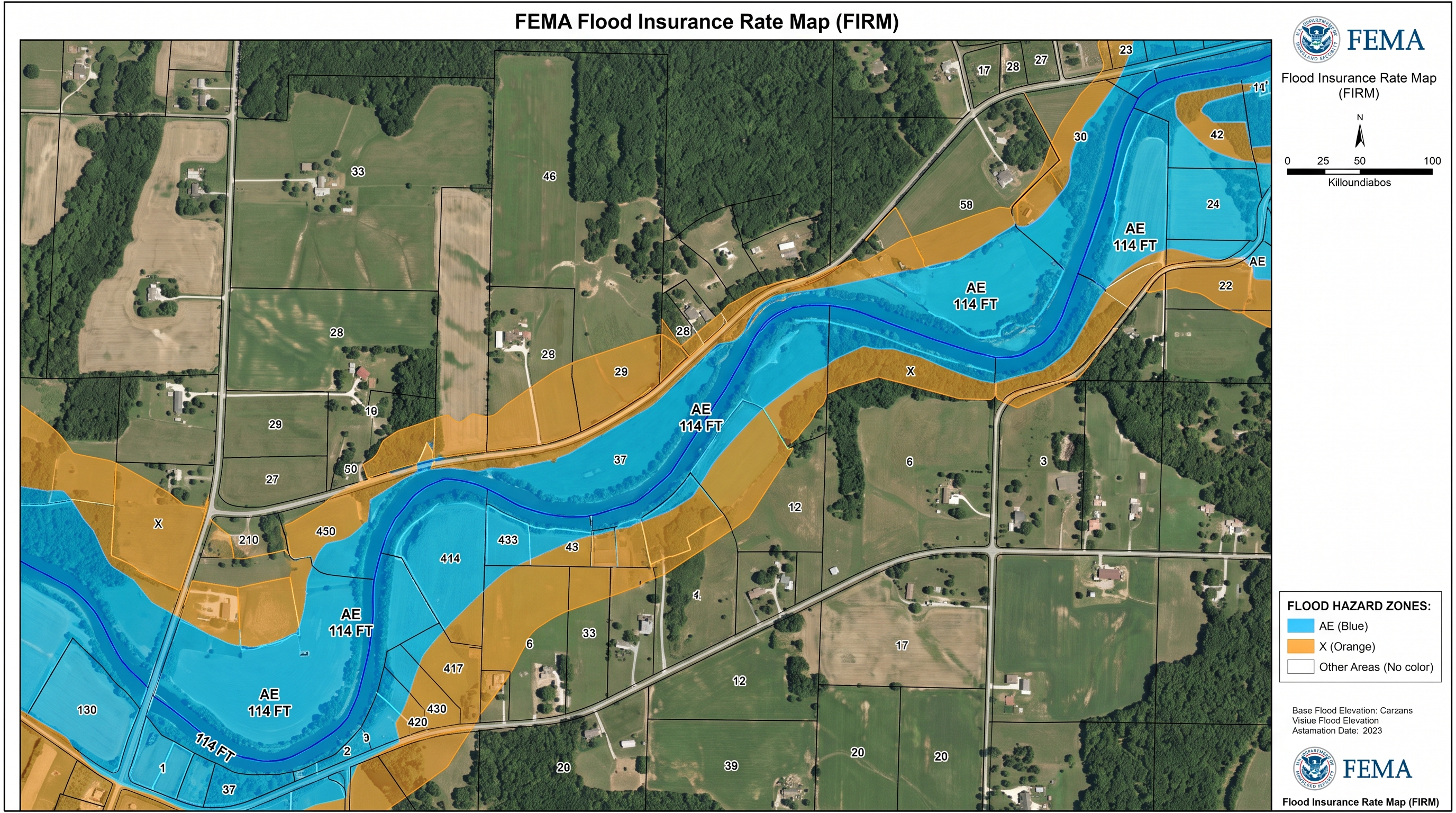
A Special Flood Hazard Area (SFHA) is any land FEMA has determined has a 1% or greater chance of flooding in any given year. This is often called the "100-year floodplain," which is a confusing name — it doesn't mean flooding only happens every 100 years. It means there is a 1-in-100 chance of flooding in any single year. Over a 30-year mortgage, that adds up to roughly a 26% cumulative flood probability.
If a property sits inside the SFHA — meaning it is in any flood zone that starts with A or V — the owner must carry flood insurance if the property has a federally backed mortgage. For cash purchases and owner-financed deals, flood insurance is not legally required, but it may still be a smart financial decision depending on the risk level.
Zones outside the SFHA (primarily Zone X) face a lower but still real flood risk. FEMA manages the National Flood Insurance Program, which has 4.7 million active policyholders across 22,600 participating communities nationwide.
Flood Zone AE: The Most Common High-Risk Designation
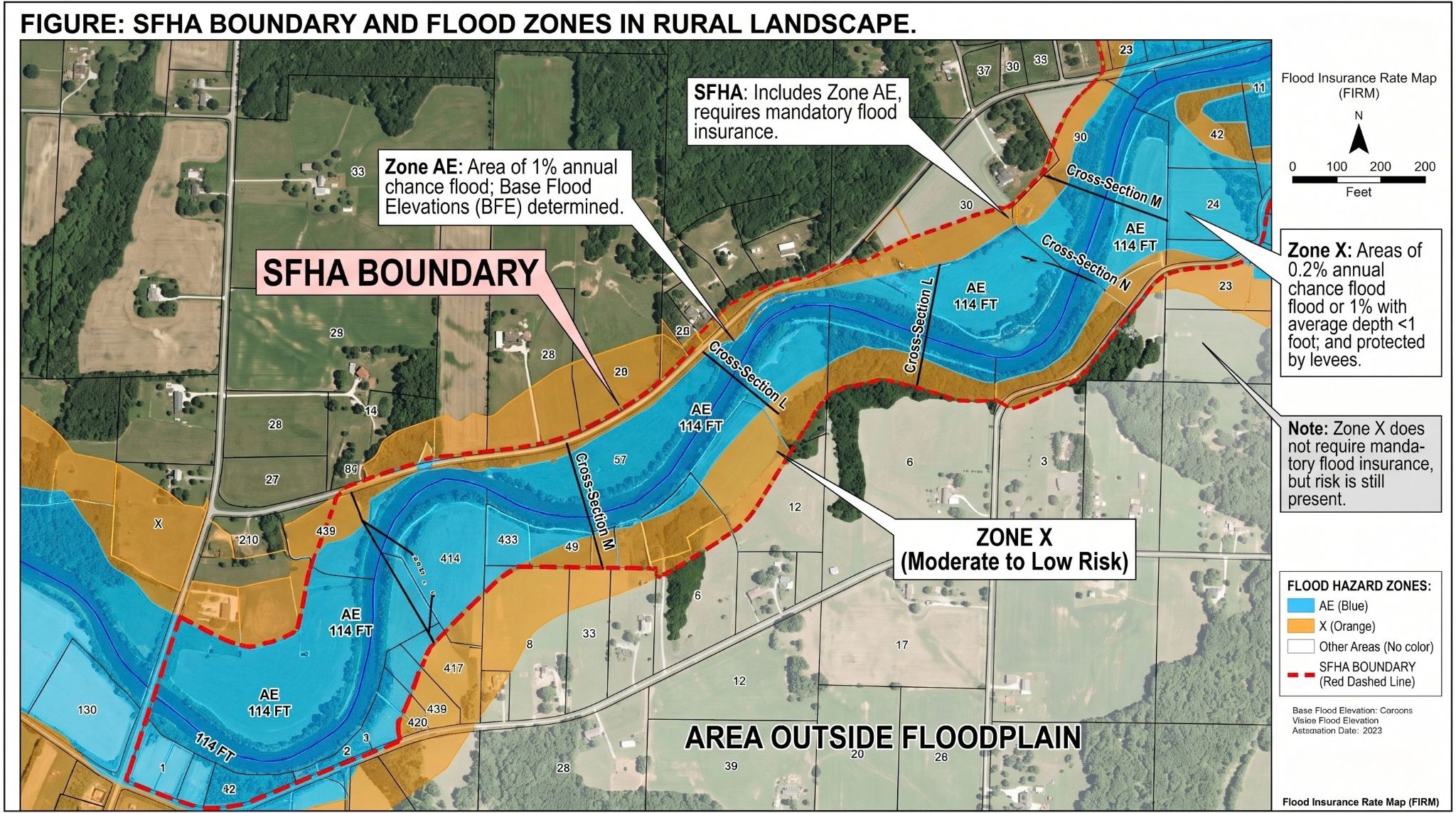
Flood zone AE is the designation you will see most often when researching rural and vacant land. It is the most thoroughly studied high-risk flood zone, meaning FEMA has done detailed engineering analysis of the area and established a specific Base Flood Elevation (BFE) for the parcel.
The Base Flood Elevation is the calculated height that floodwaters are expected to reach during a 1% annual chance flood event. This number is critical for construction. If you plan to build anything permanent on Zone AE land, most local governments require the lowest floor of any structure to sit at least one foot above the BFE — and some jurisdictions require three feet or more above BFE.
Here is what Zone AE means in practical terms for a land buyer:
Flood insurance requirement: Mandatory if you use a federally backed mortgage. Not required for cash or owner-financed deals, but strongly recommended.
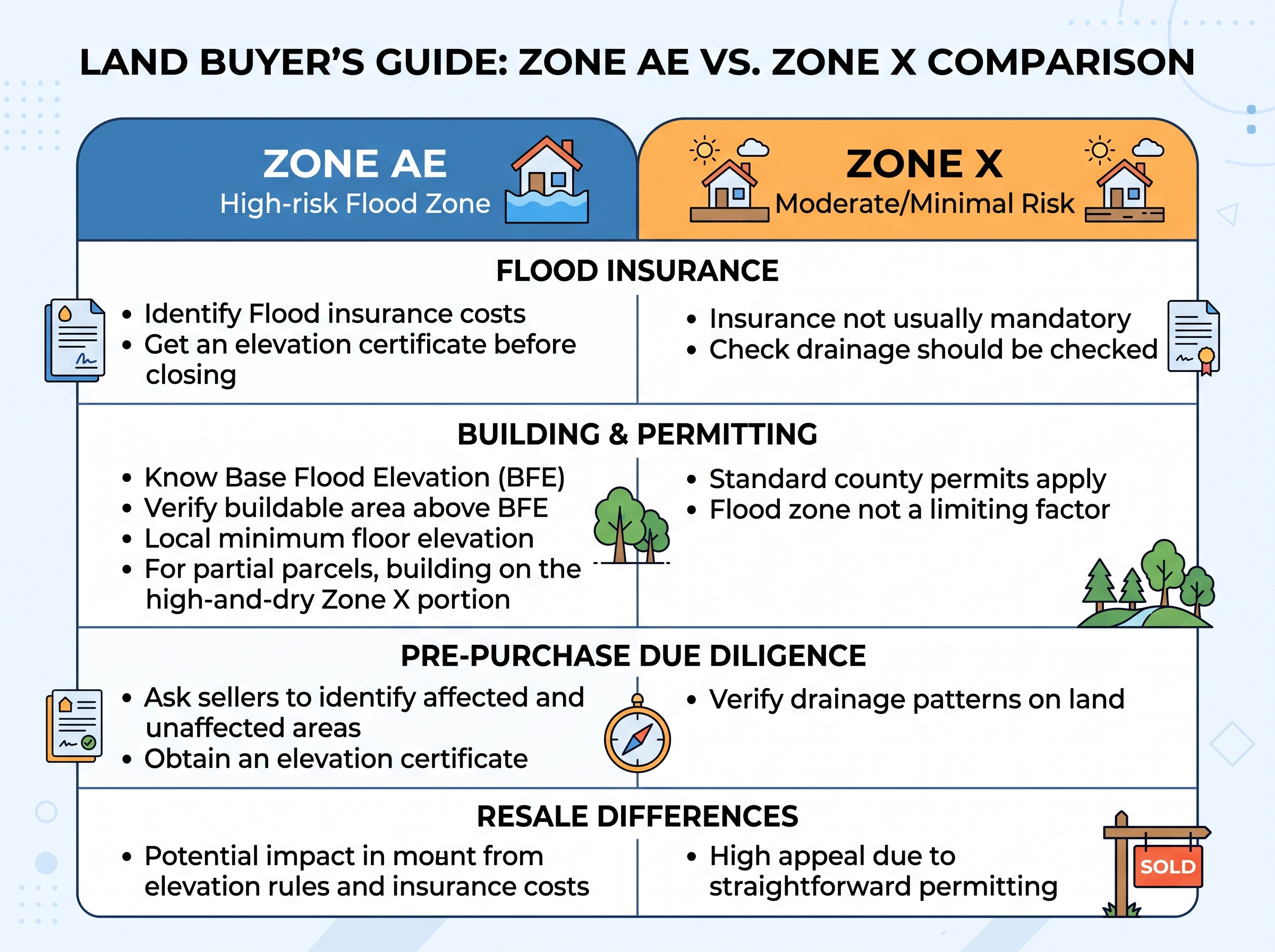
Building restrictions: Construction is permitted, but you must obtain an elevation certificate from a licensed surveyor showing your structure meets the minimum floor elevation requirement.
Resale impact: Properties in Zone AE can be harder to sell to buyers who need conventional financing, since lenders require flood insurance, which adds to the buyer's monthly costs.
Cost of flood insurance: NFIP policies in Zone AE typically run between $800 and $2,000 per year for improved properties, depending on the structure's elevation relative to BFE. Properties built well above BFE pay significantly less.
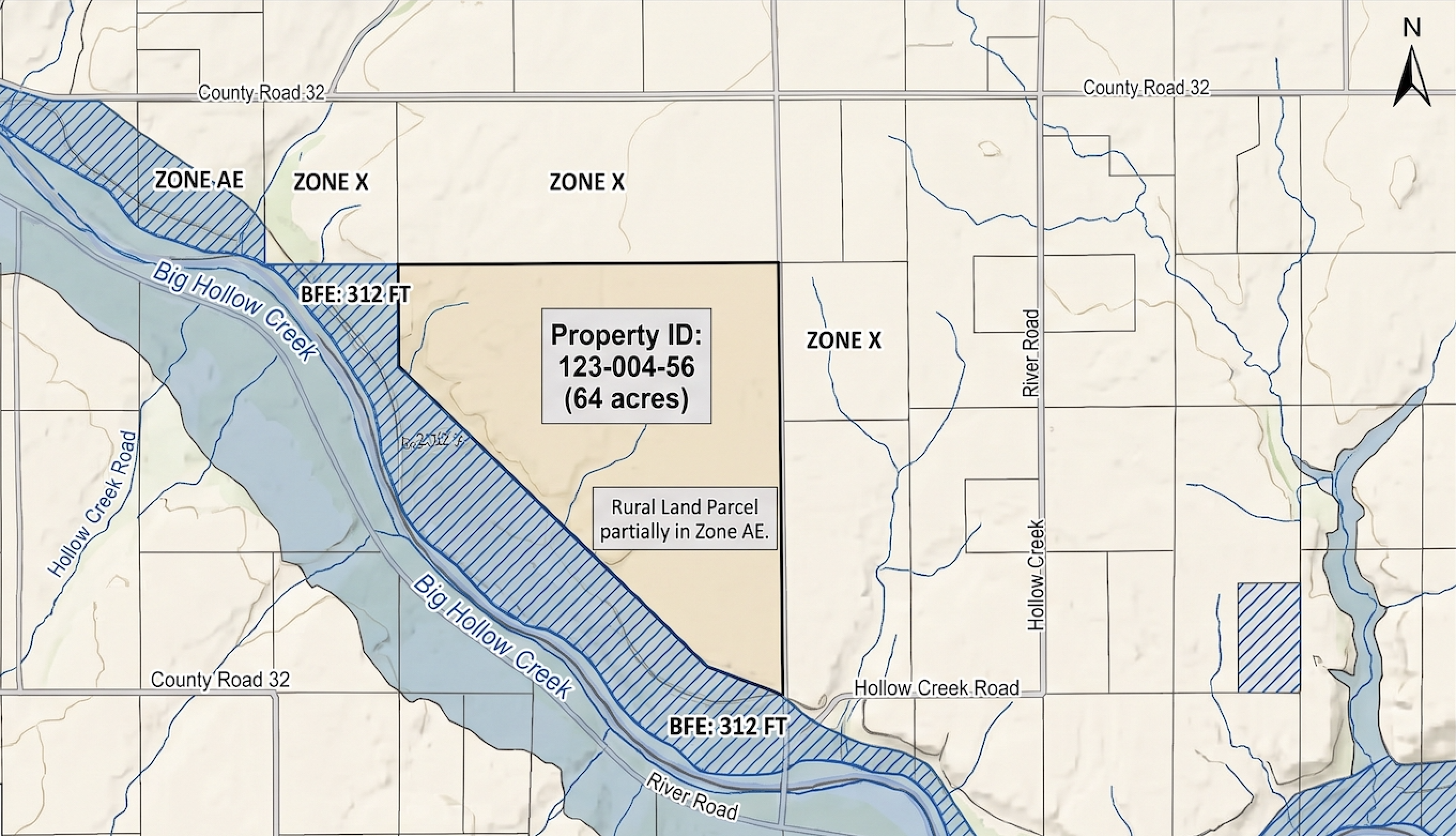
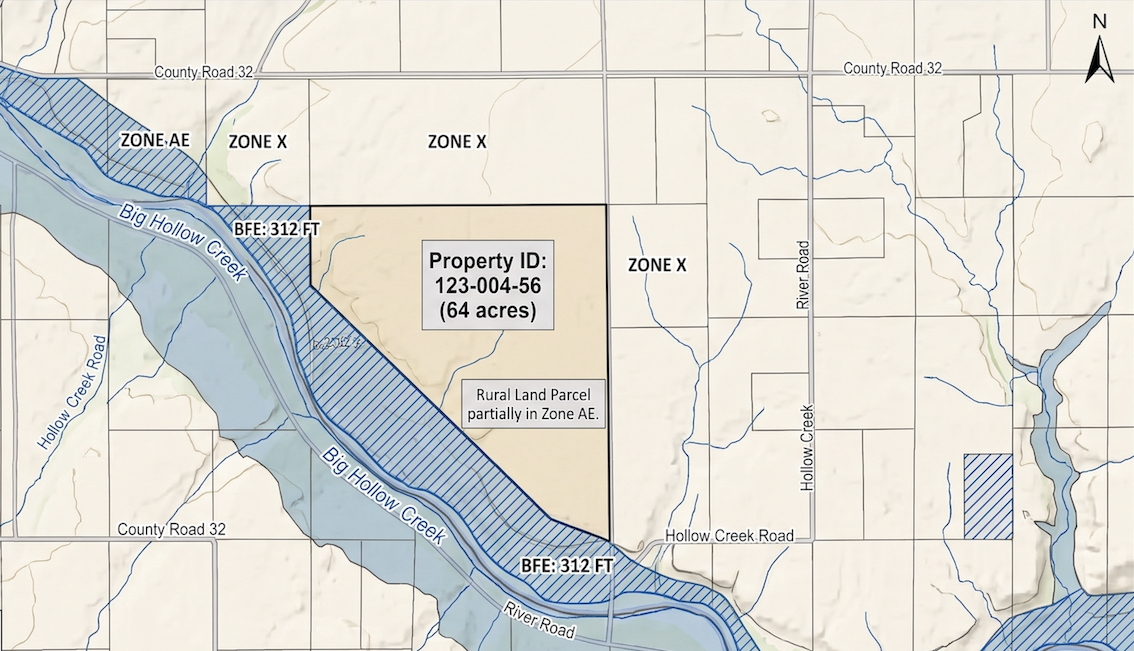
According to Andrew, co-founder of Compass Land USA, who has managed over 800 land transactions since 2017, "When we evaluate a property in Zone AE, the first thing we look at is the BFE number and how much of the parcel actually sits above it. A 20-acre parcel might have just a corner in the flood zone and the rest high and dry. That's a very different situation than a parcel where the entire buildable area is at or below BFE."
.avif)
Flood Zone A: High Risk Without Detailed Elevation Data
Flood zone A and flood zone AE both sit inside the Special Flood Hazard Area, but there is an important technical difference.
In Zone A, FEMA has identified the area as high-risk but has not yet completed the detailed hydraulic analysis needed to establish a specific Base Flood Elevation. This happens most often in rural counties where the engineering study budget has not extended to every parcel.
The absence of a BFE doesn't make Zone A any safer than Zone AE. It just means the data is less precise. For building purposes, Zone A can actually be more complicated because no one has a definitive number to work from. Local floodplain administrators typically require an applicant to commission their own elevation study before issuing a building permit.
Zone A carries the same insurance requirements as Zone AE: mandatory coverage with federally backed mortgages. If you are buying a Zone A parcel with cash or through owner financing, you have more flexibility, but the flood risk is just as real.
Flood Zone VE: Coastal High Risk With Wave Action
Zone VE appears on properties along the coast — primarily ocean-facing parcels and beachfront land in states like Florida. The V stands for velocity, meaning these areas face not just flooding but also high-velocity wave action during storm events.
Zone VE sits inside the SFHA and carries the strictest building requirements of any flood zone designation:
- Structures must be elevated on piles or columns (not a traditional foundation)
- The space below the elevated floor must remain open to allow water and wave energy to pass through
- No breakaway walls, fill, or obstruction is permitted below the BFE
- Elevation certificates are mandatory
Flood insurance in Zone VE is significantly more expensive than in Zone AE, often running $2,000 to $5,000 or more per year for an improved property, depending on the elevation and coverage amount.
For vacant land in a VE zone, building is legally possible but expensive and heavily regulated. If you are buying coastal land and see a VE designation, get a clear understanding of the buildable area and the required pile height before you make any decision.
Florida has more Zone VE land than any other state in our operating area. Felicia, co-founder of Compass Land USA, notes, "Buyers in Florida should read our Florida-specific land guide before evaluating any coastal or near-coastal parcel. The flood zone rules interact with other environmental restrictions in ways that aren't obvious from just looking at the FEMA map."
"Florida-specific land guide" → https://compasslandusa.com/post/buying-vacant-land-in-florida-the-honest-guide-2026

Flood Zone X: Low to Moderate Risk
Zone X is what most land buyers hope to see. It means the property sits outside the Special Flood Hazard Area and faces either moderate or minimal flood risk.
FEMA breaks Zone X into two sub-types:
Zone X (shaded): Also called Zone B in older maps. Sits between the 1% annual chance floodplain and the 0.2% annual chance floodplain. This is the moderate-risk zone — the property is not in the 100-year flood zone but is within the 500-year flood zone.
Zone X (unshaded): Also called Zone C in older maps. This is the minimal-risk designation. The property sits outside both the 100-year and 500-year floodplains.
Flood insurance is not required in Zone X for any type of financing. You can purchase it voluntarily, and many financial advisors recommend it given that nearly one-third of NFIP claims come from properties outside high-risk zones. Voluntary policies in Zone X typically cost $400 to $700 per year.
Zone X land generally has fewer building restrictions related to flooding and is typically easier to finance and resell than land in Zone AE or VE.
Other Flood Zone Designations You Might Encounter
Beyond AE, A, VE, and X, you may come across these designations when researching land parcels:
Zone AO: Shallow flooding areas, typically sheet flow on sloping terrain. Flood depths generally 1 to 3 feet. Found most often in areas with sloping topography and poor drainage. Building requirements include floodproofing to the depth number shown on the map.
Zone AH: Shallow flooding with ponding. Similar to AO but in flat areas that collect standing water. Flood depths typically 1 to 3 feet, with a BFE shown.
Zone AR: Areas where a flood control system is being restored or repaired. Temporary designation while FEMA reassesses risk after a dam, levee, or other control system goes offline for maintenance.
Zone D: Areas where flood hazards have been identified but FEMA has not yet studied them. Unlike Zone X, Zone D means the data is genuinely unknown rather than low-risk. Building on Zone D land carries regulatory uncertainty.
Zone AE with floodway: The floodway is the channel of the stream plus the area of land on either side needed to carry floodwaters downstream. Development in a floodway is heavily restricted because anything that blocks water flow can increase flood levels for neighboring properties.
What Flood Zones Mean When You Are Buying Land
Understanding the zone designation is only half the job. Here is what each scenario means in practical terms for a land buyer.
If the parcel is fully in Zone AE or A: You can still buy it and potentially build on it. But you need to know: the BFE for the specific parcel, how much of the buildable area sits above BFE, what the local minimum floor elevation requirement is, and what flood insurance will cost annually once you build. Get an elevation certificate before closing, or at minimum before starting construction.
If the parcel is partially in Zone AE: This is very common with larger rural parcels. A 10-acre parcel might have a creek on one end that puts two acres in Zone AE, while the remaining eight acres sit in Zone X. In this situation, building on the high-and-dry portion is straightforward. Ask the seller to identify which portion of the parcel is in the flood zone and which is not before you make an offer.
If the parcel is in Zone X: Flood zone is not a limiting factor. Standard county permits and building requirements apply. You may still want to verify the drainage patterns on the land since FEMA flood maps don't capture every low-lying area that floods in heavy rain.
If the parcel is in Zone VE: Understand that building will be expensive and heavily regulated. The view may be exceptional. The restrictions are real. Confirm what the county permits before you commit.
Felicia explains how Compass Land USA approaches flood zones for our listings: "We disclose the flood zone on every property we sell. If a parcel has land in Zone AE, we say so, we identify which portion, and we make it easy for buyers to pull up the FEMA map themselves. Land buyers deserve to know what they're getting into."
Before flood zone research, make sure you've also checked the property's zoning, utilities, and road access. These due diligence steps work together — our guide on how to check utilities on land and our guide on checking property zoning for free walk through each step.
How to Look Up a Property's Flood Zone for Free
You do not need to hire anyone or pay for a service to find a property's flood zone. FEMA provides free tools to look this up yourself.
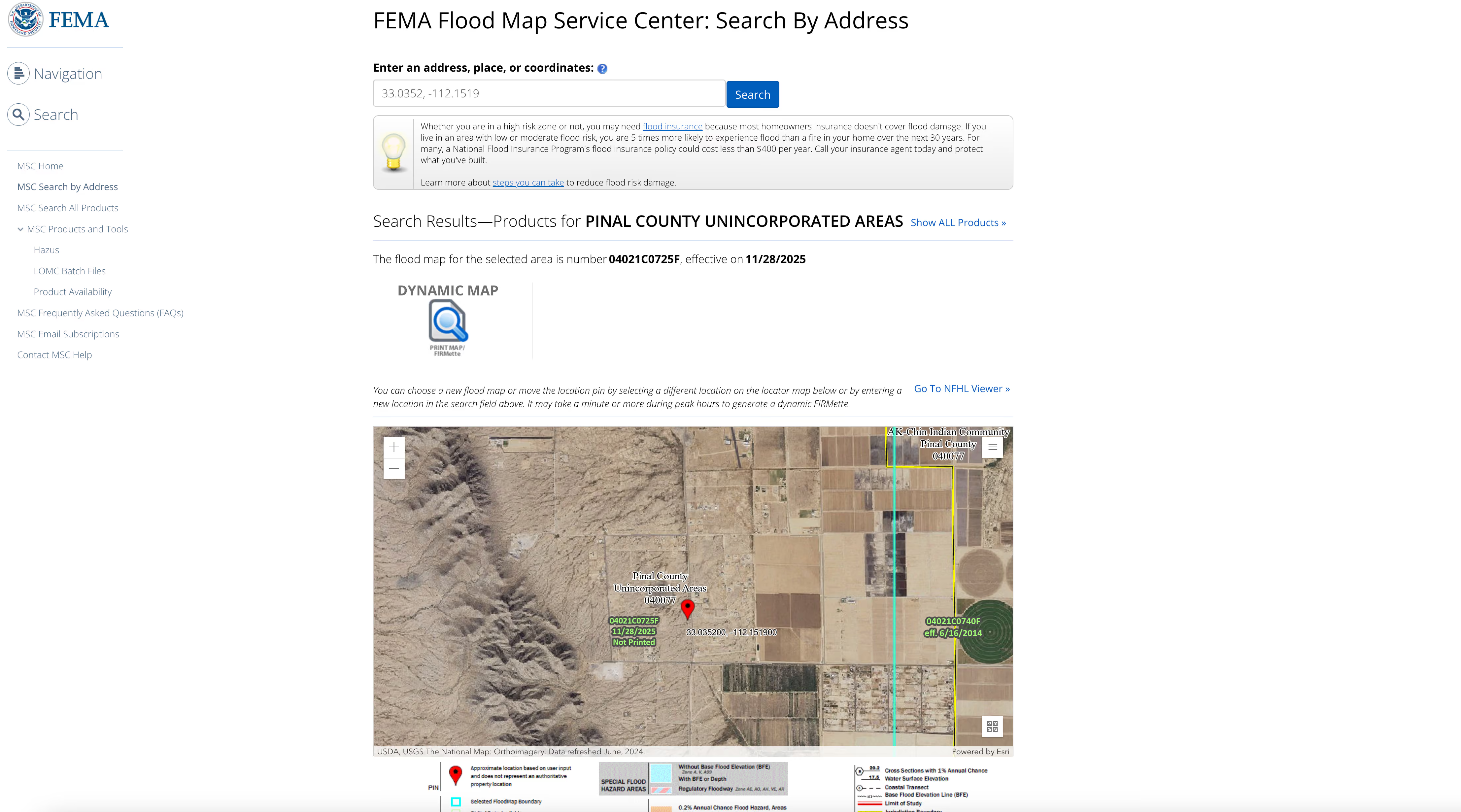
Step 1: Go to the FEMA Flood Map Service Center Visit msc.fema.gov. This is the official source. Do not rely on Zillow or third-party listing sites for flood zone information — they pull data periodically and may be out of date.
Step 2: Enter the property address Type the property's address into the search field. If the address is not recognized (common with rural vacant land), you can enter the nearest intersection or use the latitude and longitude coordinates of the parcel.
Step 3: Read the Flood Insurance Rate Map (FIRM) The result will show you the property's location on the official FIRM. The flood zone designation will be labeled directly on the map. Look for the zone code (AE, X, A, VE, etc.) in the shaded area where the property sits.
Step 4: Check the effective date of the map FIRM maps are updated periodically. The effective date appears on the map. If the map is more than five years old and the property is in a rapidly developing area, there may be a pending or recent Letter of Map Amendment (LOMA) or Letter of Map Revision (LOMR) that changes the designation. These are searchable in the same FEMA database.
Pro Tip: If you find the property is in Zone AE but you believe the land actually sits above the flood level, you can apply for a LOMA through FEMA with survey documentation. A successful LOMA can remove a parcel from the SFHA entirely and eliminate the mandatory flood insurance requirement.
For properties in Colorado, Arizona, or Nevada, also check whether the parcel is near an arroya (dry wash) that channels flash floods. These can be technically outside the mapped SFHA but still flood during monsoon season. Our article on checking property slope and elevation explains how to evaluate terrain risk using free tools.
"checking property slope and elevation" → /check-property-slope-and-elevation/]
Flood Insurance Requirements by Zone
Important: For owner-financed land purchases (no bank involved), flood insurance is never legally required regardless of zone. But the financial risk of an uninsured flood event is real. Andrew notes, "We always mention flood zone when we sell a property in AE. Some buyers in our owner-financed deals specifically ask whether they need insurance. The honest answer is: not required, but you should probably have it."
These premium estimates reflect NFIP pricing under Risk Rating 2.0, FEMA's updated pricing methodology. Private flood insurance is also available and sometimes significantly cheaper, especially for properties elevated well above the BFE. Shopping private coverage alongside an NFIP quote is always worth doing.
Three Steps to Take If a Property You Want Is in a Flood Zone
Finding a flood zone designation on a property you want to buy is not automatically a deal-breaker. Here is the right sequence.
Step 1: Identify the actual flood zone footprint on the parcel. Pull the FEMA FIRM map and look at where the zone boundary falls on the specific parcel. A partial Zone AE designation affects development plans far less than a full Zone AE parcel.
Step 2: Call the county floodplain manager. Every county that participates in the NFIP has a designated floodplain manager. Call them. Ask: What is the minimum floor elevation requirement for construction in this zone? Are there any pending map revisions for this area? What permits are required before breaking ground? This call is free and usually takes ten minutes.
Step 3: Get an elevation certificate. Before you close on any Zone AE parcel where you plan to build, commission an elevation certificate from a licensed surveyor. This document tells you exactly where the property's ground elevation sits relative to the BFE. It will determine whether flood insurance is affordable and whether building plans are practical.
If the elevation certificate shows the land is already at or above BFE, your flood insurance costs drop significantly. If it shows the land is two feet below BFE, building costs will include raising the foundation, which can add $10,000 to $30,000 or more to a construction budget.
Checking flood zones is one step in a complete due diligence process. After you confirm the flood situation, keep working through the full list: who owns the property, back taxes and liens, utility access, road access, and mineral rights.
"who owns the property" → https://compasslandusa.com/post/check-who-owns-property
"back taxes and liens" → https://compasslandusa.com/post/check-property-back-taxes-liens
"utility access" → /check-utilities-on-land/]
"road access" → /https://compasslandusa.com/post/how-to-check-property-access-and-get-coordinates-for-free
"mineral rights" → /your-bottom-line-mineral-rights/]
Frequently Asked Questions
What does flood zone AE mean?
Flood zone AE is a high-risk flood zone designated by FEMA where the land has a 1% annual chance of flooding. The AE designation means FEMA has completed detailed engineering analysis and established a specific Base Flood Elevation (BFE) for the area. Properties in Zone AE require flood insurance when financed through a federally backed mortgage, and any structures built must meet minimum floor elevation requirements set by the local floodplain administrator.
Is flood zone AE high risk?
Yes. Zone AE sits inside FEMA's Special Flood Hazard Area, making it a high-risk flood zone. Over a 30-year period, a property in Zone AE has approximately a 26% cumulative chance of flooding. You can still buy and build on Zone AE land, but you need to account for building elevation requirements, flood insurance costs, and resale considerations.
What is the difference between flood zone A and flood zone AE?
Both Zone A and Zone AE are high-risk flood zones inside the Special Flood Hazard Area. The difference is data depth. Zone AE has been studied in detail and comes with a specific Base Flood Elevation number. Zone A has been identified as high-risk but lacks detailed engineering data, so no BFE is shown. For buyers, Zone AE is actually easier to work with because there is a specific number to build to. Zone A requires more upfront study to determine construction requirements.
Can I build in flood zone AE?
Yes, you can build in Zone AE. You will need to obtain local building permits and an elevation certificate from a licensed surveyor. Most counties require the lowest floor of any habitable structure to be at least one foot above the Base Flood Elevation, though some require three feet or more. Building costs in Zone AE are higher than in Zone X because of foundation elevation requirements, but it is not prohibited.
What is flood zone X and is it safe?
Zone X means the property sits outside FEMA's Special Flood Hazard Area. Zone X (shaded) faces moderate flood risk — between the 100-year and 500-year floodplain. Zone X (unshaded) faces minimal risk. Neither requires flood insurance for federally backed mortgages. Zone X is considered safe from a regulatory standpoint, though FEMA notes that nearly one-third of all flood insurance claims come from properties outside the high-risk zone, so voluntary coverage is still worth considering.
How do I find my property's flood zone for free?
Go to the FEMA Flood Map Service Center at msc.fema.gov and search by the property's address or coordinates. The official Flood Insurance Rate Map (FIRM) will show the property's location and flood zone designation. This is free, takes about five minutes, and uses the most current FEMA data available. Do not rely on real estate listing sites for flood zone information — always check the primary FEMA source.
Do I need flood insurance on owner-financed land in Zone AE?
If you buy through owner financing, no lender can legally require flood insurance because there is no federally backed loan. That said, the flood risk in Zone AE is real regardless of how you financed the purchase. If you plan to build on the land, your construction lender may require flood insurance when you apply for a building loan. Even if no one requires it, it is worth pricing out a policy before you buy so you know what the annual carrying cost looks like.
What is a Letter of Map Amendment (LOMA) and do I need one?
A LOMA is an official letter from FEMA that amends the flood map to remove a specific structure or parcel from the Special Flood Hazard Area when an elevation survey shows it actually sits above the Base Flood Elevation. If you own land designated as Zone AE but survey data shows it is above BFE, you can apply for a LOMA. If approved, it removes the mandatory flood insurance requirement. The application is free and takes 60 to 90 days on average.
Make Flood Zone Research Part of Your Due Diligence
Flood zones are one of the most misunderstood parts of buying raw land. The zone code on a map doesn't tell you whether a property is a good deal — it tells you what the rules are. From there, it is your job to figure out whether the rules work for your plans.
Zone AE land near a creek in Colorado is a completely different situation from Zone AE land on a Florida coastal lot. Context matters. Elevation matters. Your intended use matters. The research you do now protects you from expensive surprises after you close.
You do not have to figure this out alone. If you have questions about the flood zone on a specific property, or you want to browse parcels where we have already done the due diligence, call or text Andrew anytime at (313) 349-0434. You can also browse available properties at compasslandusa.com, where we disclose the flood zone status on every listing.
"browse available properties" → https://compasslandusa.com/lands-for-sale
Felicia
Co-founder, Compass Land USA
Andrew co-founded Compass Land USA after buying and selling land for years without needing a single bank. He's been on both sides of hundreds of owner-financed deals across five states.
You've Read Enough. Time to Own Something.
Ready to Stop Renting Your Life and Start Owning Something?
Browse available land in Arizona, Colorado, Florida, Nevada, and North Carolina. Owner financing on every parcel. No bank. No credit check. Close in days.