
Protect Yourself
Before You Buy
How to Check Property Slope and Elevation for FREE
Slope and elevation affect your build costs, flood risk, and what you can do with a parcel. Here are 4 free tools to check before you buy. No site visit required.

How to Check Property Slope and Elevation for Free
You can check a property's slope and elevation for free using your county's online GIS map or the USGS National Map. Search the parcel number, turn on the topography or elevation layer, read the elevation lines that cross your lot, then divide the rise in feet by the run in feet to get a slope percentage. It takes about ten minutes and no special software.
 check who owns the property first, then check for back taxes and liens, check the zoning, check access and get coordinates, and check existing utilities. Slope and elevation round out the list, and like the rest of them, you can do this one from your couch.
Why Slope and Elevation Matter Before You Buy
A steep or uneven lot is not usually a dealbreaker for rural or vacant land. Most raw land has some grade to it, and a gentle slope can even help with drainage. Where it gets real is a property in a flood zone or flood plain, or a slope so severe it limits where you can build, park an RV, or even walk comfortably.
"This is normally not a dealbreaker for rural and vacant land. Unless you're looking at a property in a flood zone or flood plain, or if the property slope is really severe." (Andrew, from CLUSA's original Due Diligence video series)
Knowing the topography matters most when the road access is already limited or difficult. A dirt road that climbs a steep grade behaves very differently after rain or snow than a flat gravel approach. Elevation also tells you things a listing photo never will, like whether your building site sits above or below the surrounding land, which matters for water runoff, for wind exposure at higher elevations, and for line of sight if a view is part of why you're buying.
What You Need Before You Start
You need two things: the county the land sits in, and the parcel number (also called the APN, or Assessor's Parcel Number). That's it.
If you found the property on a land marketplace, Craigslist, or even Facebook Marketplace, the parcel number is usually right there in the listing. If it isn't, ask the seller directly.
"If the seller does not have the parcel number or cannot get it for you, that is a big red flag. It increases the likelihood of that seller being a scam or not having the rights to actually sell you that property." (Andrew, from CLUSA's original Due Diligence video series)
A legitimate seller can produce the parcel number in minutes, because it comes straight off the county's own tax and property records. If someone can't, or won't, walk away before you send any money.
How to Find Elevation Data for Free
There are two solid, no-cost ways to check a property's elevation and slope. Use whichever one gives you clearer data for your specific county, or check both.
1. Your county's GIS map. Most counties across Arizona, Colorado, Florida, Nevada, and North Carolina, the core states CLUSA works in, publish an online GIS (Geographic Information System) map where you can search a parcel number and pull up topography lines for free. Search "[County name] GIS map" in Google to find it.
2. USGS National Map / 3D Elevation Program. For a county-independent source, the U.S. Geological Survey's 3D Elevation Program offers free elevation viewers and downloadable digital elevation models for the entire country, no account or login required. It's a good second opinion when a county's GIS system is outdated or missing a layer, and it's the same underlying data most professional surveyors and engineers pull from. The USDA's Web Soil Survey is a third free option. It covers soil and slope data for more than 95% of U.S. counties and layers it with land cover and hydrology, useful if you also want to know what's growing on the lot.

Some counties run more than one GIS system, and their data won't always match perfectly. If your county has two, check both and use the newer one for anything besides topography, since older systems sometimes carry outdated ownership records even while the elevation data underneath stays accurate.
Step-by-Step Example: A Real Colorado Parcel
Here's the exact process, walked through on a real example property: a lot in Costilla County, Colorado, parcel number 70273760.
Step 1: Search the county GIS map. Google "Costilla County GIS maps" and open the county's mapping portal.
Step 2: Search the parcel number. Type in 70273760 and press enter to zoom to the lot.
Step 3: Turn on the topography layer. Look for a "Basemaps" or "Layers" menu, then select the topography or ESRI Topography option. Turn off the parcel boundary layer temporarily if it's making the elevation lines hard to read.
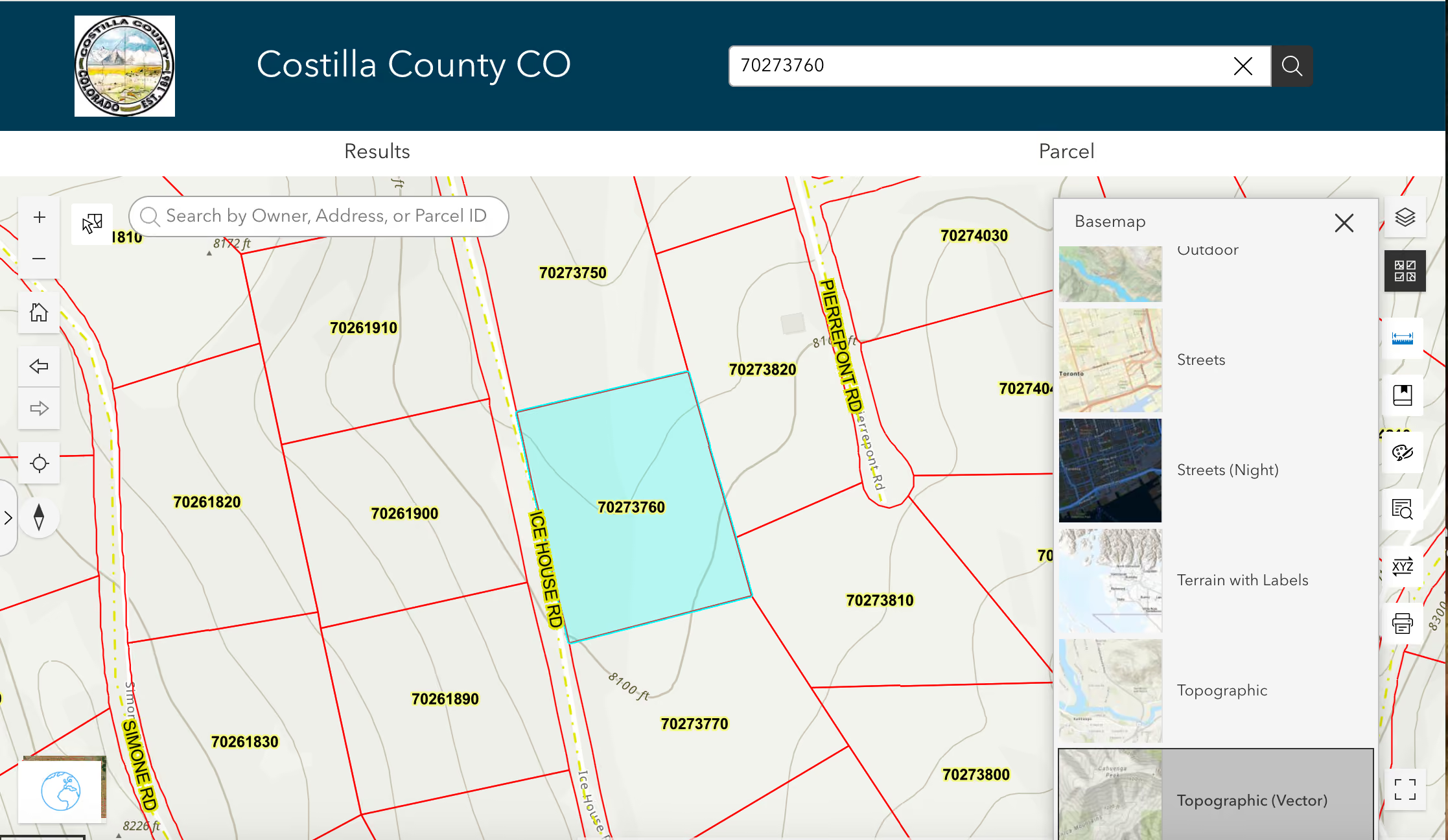
Step 4: Read the elevation lines. Zoom into the parcel until you can see the topography contour lines crossing it, and find the number labeled on each line. On this example, one line reads 8,100 feet. That's the property's elevation at that point on the lot.
![grade slope property - elevation contour line at 8,200 feet]](https://cdn.prod.website-files.com/69da40dd636aba36c970f2e8/6adf88618f48eb7f6a086923_Screenshot%202026-10-12%20at%209.54.06%E2%80%AFAM%20(1).avif)
Step 5: Measure the distance between two elevation lines. Use the map's built-in measurement tool to draw a line from the first elevation contour to the edge of the property, or to the next contour line. In this example, that distance came out to roughly 261 feet.
Step 6: Find the second elevation reading. Track down the next labeled contour line nearby. In this example, the lines were 8,080 feet and 8,120 feet, spaced in 20-foot increments, meaning the next line in is 8,100 feet.
How to Calculate Slope Yourself
Once you have two elevation points and the distance between them, the math is the same formula from high school geometry: slope equals rise over run.
Rise is the change in elevation. Run is the horizontal distance between the two points. In the Costilla County example, the rise is 20 feet and the run is 261 feet. Divide 20 by 261 and you get 0.0766. Multiply by 100 to turn that into a percentage, and you land on roughly 7 to 8 percent slope for that section of the property.
A 7 to 8 percent grade is a gentle, walkable slope, the kind you'd barely notice unless you were looking for it. On this particular parcel, the northern side of the lot had wider spacing between contour lines than the southern side, which is a sign the land flattens out even more in that direction. That's a useful thing to know before you decide where to put a driveway, a home site, or an RV pad.
What Counts as a Steep Slope
There's no single number that applies everywhere, since it depends on what you're planning to build and which county's rules apply. A few general benchmarks are worth knowing:
- 0 to 5%: Flat to gently sloped. Easiest and cheapest to build on, with minimal grading.
- 5 to 15%: Moderate slope. Still buildable in most cases, but expect some grading or a stepped foundation.
- 15 to 33%: Steep. Many counties start requiring additional site work, drainage plans, or engineering review somewhere in this range, and it varies by jurisdiction.
- Over 33% (a 1-foot rise for every 3 feet of horizontal distance): This is the threshold written into the International Building Code, section 1808.7, where foundations on or adjacent to slopes this steep require an engineer's review in most jurisdictions that have adopted the code. Above this grade, expect real engineering costs before you can build.
Check your specific county's building department for their exact threshold, since local amendments to the code are common. This isn't a reason to avoid a sloped parcel. It's information that tells you what to budget for and what to ask before you commit.
How Slope Connects to Flood Risk and Access
Slope and flood risk aren't the same thing, but they're related. A low, flat elevation near a river, wash, or drainage area is more likely to sit inside a mapped flood zone, while a lot on a hillside is less likely to flood but may deal with runoff, erosion, or a harder approach in bad weather. If your GIS check turns up a low-lying, mostly flat parcel, it's worth cross-checking it against a flood map before you go further. We cover this in more depth in our guide to understanding flood zone types and in what the FEMA zone letters (AE, A, VE, X) mean. FEMA's own Elevation Certificate is the official document that ties a specific structure's elevation to the flood risk on record, and it's worth requesting if you're building near a mapped flood zone.
If your land is in Florida, flood and elevation questions carry extra weight, since a meaningful share of Florida land sits in mapped flood zones or wetlands. See what to do if your land is in a flood zone and buying land in a Florida wetland area before you move forward on any low-lying Florida parcel.
Access ties in here too. A steep, difficult approach road matters more on a rainy day than it does on a dry one, and it can turn a short drive into a real problem in winter. If you haven't already, check the road access and get the exact coordinates for any property before you buy it, sloped or not.
Three Red Flags to Watch For
1. Steep slope plus limited access. A grade over 15 to 20 percent combined with a dirt or unmaintained road is worth a phone call to the county before you commit. Ask directly how the road is maintained in winter or after heavy rain.
2. No elevation data available anywhere. If neither your county's GIS system nor the USGS National Map shows anything for a parcel, that's unusual enough to ask questions about. It doesn't mean something's wrong, but it's worth a call to the county assessor to confirm the parcel exists exactly where the seller says it does.
3. A flat, low-lying lot near water with no flood zone disclosure. If the elevation reads low and close to a wash, creek, or drainage area, and nobody has mentioned flood zone status, check it yourself using FEMA's Flood Map Service Center before you sign anything.
What to Do If the Land Is Sloped
A sloped lot is not automatically a bad buy. Plenty of homesteaders and off-grid buyers choose sloped land on purpose, for the drainage, the views, or because it's priced lower than the flat parcels nearby. What changes is the plan.
On a moderate slope, expect to budget for some grading or a foundation built for the grade rather than flat ground. On a steep slope, get a local contractor or engineer to look at the specific building site before you finalize plans, not after. And on any slope, walk the actual building envelope in person if you can, since a topography map tells you the shape of the land, but only a walk tells you what the ground feels like underfoot.

If you're planning to put a cabin, manufactured home, or modular home on sloped land, our guide to building a cabin on vacant land covers permits and county rules in more detail, and buying land for a mobile or manufactured home walks through the foundation and setup requirements specific to those home types.
Where This Fits in Your Full Due Diligence Checklist
Slope and elevation are the last of six checks in our free Due Diligence series, but they're only useful alongside the rest of it. Before you commit to any parcel, you want to have confirmed who legally owns it, whether back taxes or liens are attached, what the zoning allows, what the access and exact coordinates look like, what utilities already exist, and now, the shape of the ground itself. Our full questions-to-ask checklist pulls all six into one place if you want the complete picture before you make an offer.
"So at this point, you can make an informed decision on whether or not you want to move forward with purchasing the property." (Andrew, from CLUSA's original Due Diligence video series)
None of this replaces a legal or engineering review. It's a starting point that catches the major issues before you spend real money finding them the hard way.
Buy Land With the Due Diligence Already Done
We build every listing on our site with this kind of due diligence already done, including topography, so you're not the one hunting down GIS maps at 11pm before an offer deadline. If you want to see what's currently available with owner financing already worked out, no banks, no credit checks, no prepayment penalties, no hassle, browse current listings or grab our free owner financing guide to see how the payment side works before you talk to us.
Once you've found land you like, we walk you through exactly what happens after you buy it in the first 30 days, including the steps that matter most in the early weeks.
If you have questions about a specific parcel's slope, elevation, or anything else on this list, call or text Andrew and Felicia anytime at (313) 349-0434. We'll be happy to help.
FAQ
Can I check a property's slope and elevation without hiring a surveyor?
Yes. County GIS maps and the free USGS National Map give you a reliable elevation and topography picture for due diligence purposes. A licensed surveyor is a different level of precision, and worth hiring once you're under contract and need exact numbers for construction or an elevation certificate, but not for the initial buying decision.
What percent slope is considered too steep to build on?
There's no single national number, but slopes over 33.3% (a 1-foot rise for every 3 feet of horizontal run) trigger engineered foundation requirements under the International Building Code in most adopting jurisdictions. Many counties start asking for extra site work somewhere between 15% and 33%. Check your specific county's building department for their exact rule.
Does a sloped lot affect whether I can put a mobile or manufactured home on it?
It can. Manufactured and mobile homes typically need a level, prepared pad, so a sloped lot may need grading work before installation. This varies by county and by how steep the specific building site is, so check with the local building department before you buy if this is your plan.
How accurate is county GIS elevation data compared to a professional survey?
County GIS topography data is generally accurate enough to understand a parcel's overall shape and grade for buying decisions. It's not survey-grade precision. If you need exact elevation numbers for construction, an elevation certificate, or a variance request, hire a licensed surveyor once you own or are under contract on the property.
Does a steep slope mean the land is in a flood zone?
No, and it usually points the other way. Low, flat elevation near water is more commonly associated with flood risk, while steep slopes are more likely to deal with runoff and erosion instead. Check FEMA's Flood Map Service Center directly rather than assuming either way based on slope alone.
What if my county does not have GIS topography data online?
Use the USGS National Map or the USDA Web Soil Survey instead, both cover the entire country and don't depend on your specific county's system. If neither shows useful data for a parcel, call the county assessor's office directly and ask them to confirm the parcel's location and any topography records they have on file.
Can I still buy land with a steep slope?
Yes. Plenty of buyers choose sloped land on purpose, for the view, the drainage, or the lower price. What matters is knowing the grade ahead of time so you can budget for grading or foundation work, and talking to a local contractor before you finalize any building plans on a steep site.
Why do I need the parcel number before I can check slope and elevation?
The parcel number, also called the APN, is how county GIS systems and most mapping tools locate the exact boundaries of a specific piece of land. Without it, you're searching by address or coordinates, which works in some counties but not all. A legitimate seller can always provide the parcel number, and if they can't, treat that as a warning sign.
Andrew
Co-founder, Compass Land USA
Andrew co-founded Compass Land USA after buying and selling land for years without needing a single bank. He's been on both sides of hundreds of owner-financed deals across five states.
You've Read Enough. Time to Own Something.
Ready to Stop Renting Your Life and Start Owning Something?
Browse available land in Arizona, Colorado, Florida, Nevada, and North Carolina. Owner financing on every parcel. No bank. No credit check. Close in days.